Union Budget 2026 Updates
- TCS on overseas tour packages reduced to 2%, easing cash flow for travellers.
- TCS on education and medical expenses under LRS reduced to 2%.
- TDS on manpower supply services standardised at 1% or 2%, reducing confusion.
- For NRIs selling property in India, TDS will now be deposited using the buyer’s PAN instead of TAN, simplifying compliance.
What is Section 194J of the Income Tax Act?
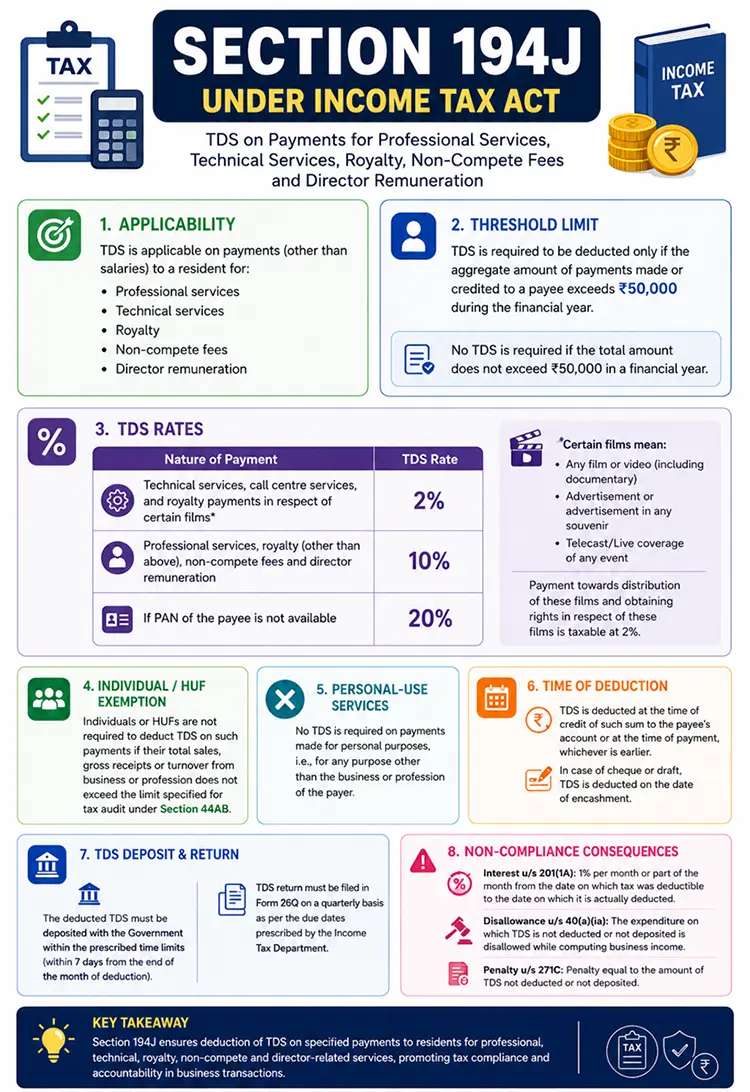
Section 194J covers the TDS against payment for professional fees (10%), royalty (10%), technical fees (2%), and directors’ remuneration (10%).
Section 194J of the Income Tax Act states the provisions for the mandatory tax deduction at source against the payments made for technical fees and professional fees. TDS is deducted under section 194J if the payment exceeds Rs. 50,000 during a financial year. The TDS rate is 10% in general, but can be different based on the type of service, with the requirement to deduct 1% (individuals & HUFs) & 2% TDS (other cases) for technical services.
Who is Required to Deduct TDS u/s 194J?
As per Section 194J, section, any person (other than an individual or HUF who is not covered u\s 44AB in the preceding FY) who pays fees to residents for professional or technical services will be required to deduct tax at source u/s 194J.
However, individuals or HUFs will be required to deduct TDS if they are liable to audit u/s 44AB (a) and (b).
The person here means :
- Central or State Government
- Local Authority
- Corporation
- Company
- Cooperative Society
- Trust
- University
- Registered Society
- Firm
- Individual/HUF/AOP/BOI must get accounts audited u/s 44AB (a) and (b)
The following persons are not required to deduct TDS under section 194J -
- Individuals or HUFs running a business with a turnover up to ₹1 crore in the previous financial year
- Individuals or HUFs practicing a profession with gross receipts up to ₹50 lakh in the previous financial year
In short, all entities, except individuals or HUFs not liable for a tax audit in the preceding year, must deduct TDS on such payments. If Section 194J doesn’t apply, Section 194M may still be relevant.

Types of Payments Covered Under Section 194J
The following types of services are covered under section 194J:
-
Professional Fees
This refers to services provided by professionals in fields such as medicine, architecture, civil engineering, accountancy, interior design, advertising, and professional consulting. Additionally, it includes any other profession notified by the Board under Section 44AA of the Income Tax Act.
Recognized professions under Section 44AA also encompass film writers, company secretaries, and authorized representatives.
Furthermore, individuals involved in sports and media, such as athletes, event organizers, journalists, anchors, umpires, coaches, physiotherapists, team doctors, and sports columnists, are also included under this provision. TDS on professional fees is applicable as per section 194J of the Income Tax Act.
-
Technical services fees
These services refer to consulting, managerial, and technological services provided by an employee. Managerial services can be defined as the running and management of the client’s business. Consultancy services are advisory services where necessary advice and consultation are given to clients for their business. The list of technical services under section 194J includes, engineering, advertising, accountancy, medical, architecture, etc.
- Directors’ fees:
The remuneration or fees paid to the directors of the company, except salary. These include sitting fees for attending board meetings.
-
Non-Compete Fees
Under Section 194J, non-compete fees refer to payments made in cash or kind as part of an agreement that restricts an individual from sharing or utilizing any patent, license, contract, trademark, know-how, commercial or business rights, techniques, or information. These restrictions apply to their use in manufacturing, production, or any other related operational activities.
-
Royalty
- Transfer of Ownership: Ownership rights of a patent, invention, formula, blueprint, concept, or trademark.
- Usage Rights: Utilizing an invention, blueprint, patent, or similar intellectual property.
- Sharing Information: Accessing detailed information about the use of an invention, copyright, algorithm, or similar assets.
- Equipment Usage: Using or granting the right to use equipment for agricultural, research, or commercial purposes.
- Broadcast and Media Rights: Transferring rights for published works, experimental discoveries, documentaries, or videotapes for radio broadcasting, with limited permissions for sale, presentation, or distribution.
-
Specific Cases
TDS deduction under Section 194J is also applicable in the following cases, as clarified by departmental case laws and circulars:
- Payments for medical services provided by hospitals.
- Professional fees paid by film artists to publicity companies.
- Fees paid to management firms and HR consulting firms.
- Payments made to registrars for data exchange services.
TDS Exemption Limit Under Section 194J
Note: 194J TDS limit for FY 2025-26 is Rs. 50,000. This means TDS must be deducted if the payment in an year exceeds Rs.50,000.
Now, a question may arise in your mind: is this threshold limit the overall limit for all services covered u/s 194J, or it shall be calculated individually for payment of professional fees or technical fees etc.
This limit of Rs. 50,000/- is not a total limit for all services. Payment shall be calculated individually for professional fees, technical fees, royalty fees, or non-competence fees.
Example 194J applicability: XYZ Ltd made the Following payments to Mr. A
| Particulars |
Amount |
| Payment made for professional services |
Rs. 25,000 |
| Payment made for technical services |
Rs. 20,000 |
| Total payment to Mr. A |
Rs. 45,000 |
| TDS is not required to be deducted in the above case |
XYZ Ltd is not liable to deduct TDS from payments made to Mr. A Since INR 50,000 is a separate limit for professional services and fees for technical services, etc.
What is the 194J TDS Rate and Limit for FY 2025-26?
Given below is a table that shows the TDS on professional fees limit for FY 2025-26.
194J TDS rate:
| Nature of payments |
Rate of tax deduction |
Threshold Limit |
| Payment of technical service fees |
2% |
Rs. 50,000 |
| Payments made to operators of call centers |
2% |
Rs. 50,000 |
| Payment of royalty for sale, distribution or exhibition of cinematographic films. |
2% |
Rs. 50,000 |
| Other Royalty |
10% |
Rs. 50,000 |
| All other payments covered under this section (Like Professional Services) |
10% |
Rs. 50,000 |
| The payee does not furnish his/her PAN |
20% |
Rs. 50,000 |
| Payments made by the company to directors by way of fees, commissions or remuneration |
10% |
Nil |
Time Limit for Deposit of TDS
The tax has to be deducted at the time of -
Passing such entry in the books of accounts or,
Making the actual payment of the expense, whichever is earlier.
| Payment Type |
Non-Government Deductors |
Government Deductors |
| Payment made before 1st March |
7th day from the end of the month |
7th day from the end of the month |
| Payment made in March |
April 30th |
April 30th |
Some Special Considerations by CBDT(Government) Circular on 194J Applicability
CBDT has made some special announcements relating to the implications of section 194J, which are as follows:
Routine maintenance contracts
Any payment made for routine maintenance contracts (including the supply of spares) will be liable to TDS u/s 194C. But if such payment is made for giving any technical services, then Section 194J will become applicable.
Recruitment agencies
Any payment made to recruitment agencies (like Monster India or Naukri.com, etc.) will be subject to TDS u/s 194j of the Income Tax Act.
TDS Deduction on GST Amount
The TDS under this section will only apply to the amount (excluding GST) if the GST value is shown separately on the bill.
Media House
Any payment (in the form of commission) paid by a media house (like TimesNow) to any advertising agency (like FoxyMoron) will be liable to TDS u/s 194J.
When is the TDS Statement Issued and by Whom u/s 194J?
TDS statement, known as Form 16A is issued by the specified person who is required to deduct TDS. Form 16A is issued to the deductee (i.e., whose TDS is deducted from the income). Given below are the due dates for issuing the TDS certificate:
| Particulars |
Due Date |
| April- June |
15th Aug |
| July - September |
15th November |
| October - December |
15th February |
| January - March |
15th June |
Consequences of Non-deduction or Late Deduction of TDS
The employer or the person liable to deduct TDS fails to deduct the TDS or fails to deposit it with the government and may be subject to interest and penalty imposed by the Income Tax authorities.
Disallowance of expenditure:
Non-deductible payments: According to Section 40(a)(ia) of the Income Tax Act, any amount (except salary) paid outside India or to a non-resident, which is taxable in India in the hands of the receiver, shall not be deducted if it is paid without withholding tax or if tax is withheld but is not remitted to the Central Government till the deadline of filing of return.
However, if tax is withheld or remitted in the next year, as the case may be, the payment shall be deducted in that year.
Moreover, according to Section 40(a)(ia), any amount paid to a resident, which is subject to withholding tax, would attract 30% non-deductibility if it is paid without withholding tax or if tax is withheld but is not remitted to the Central Government till the deadline of filing of return.
Levy of Interest:
Any individual who is liable to deduct TDS but fails to deduct it wholly or partly or does not pay it to the government will be subject to pay interest. The interest rate is:
- 1% per month or part of a month on the TDS amount from when the TDS was to be deducted.
- 1.5% per month or part of a month on the TDS amount from when TDS was deducted to when it was actually paid.
The assessee has to pay this interest before furnishing the TDS statement.
Levy of Penalty:
If the assessee is liable to deduct or pay TDS and does not deduct (under sections 192 to 196D) or deposit as per Chapter Section 115-O(2), or the second proviso to Section 194B, the deductor may face a penalty U/S 271C of the Income Tax Act. The penalty amount can be equal to the TDS he failed to deduct or deposit.
If the assessee does not pay the tax demand raised by the assessing officer, the assessee may face another penalty under Section 221 of the Act. The penalty amount can vary depending on how long the payment is delayed; however, the penalty amount can not exceed the tax demand.
Prosecution:
If a person deducts the tax at source and is liable to deposit it to the government and fails to do so, he can be sentenced to imprisonment for a minimum of 3 months, and the sentence can be extended to a maximum of 7 years. Read more here.
Examples of TDS on Professional Fees and Technical Services
Example 1: TDS on Professional Services Rendered
-
Payments made:
- ₹60,000 in May 2025
- ₹30,000 in Jan 2026
- Service provider: Ms. Neha (professional)
- Service receiver: Ms. Meghna
Situation 1: Meghna is not liable for audit (Section 44AB)
No TDS applicable.
If the payer is not liable for tax audit, TDS under 194J is not required.
Situation 2: Meghna is liable for audit, but services used for personal purpose
No TDS applicable.
TDS under 194J applies only when services are used for business or profession, not personal use.
Situation 3: Meghna is liable for audit + services used for business
TDS @ 10% is applicable.
Audit liability + business use triggers TDS deduction u/s 194J.
TDS calculation
First payment ₹60,000 → TDS @10% = ₹6,000
Threshold of ₹50,000 crossed, so TDS applies from this payment.
Second payment ₹30,000 → TDS @10% = ₹3,000
Once the limit is crossed, TDS applies on all further payments.
Example 2: TDS on Professional Services – Sports Coaching
Case: A Tennis Academy pays ₹8,00,000 annually to Mr. Arun (coach).
- Sports coaching = professional service under Section 194J.
Coaching activities fall under notified professions.
- Payment exceeds ₹50,000 threshold.
Any payment above the limit attracts TDS.
- TDS @10% = ₹80,000 must be deducted.
The academy must deposit this amount with the government.
You now know the basics of TDS on professional fees and technical services, including the deduction limits, rates, and timings. But tax computation can still be a challenge for a non-finance person. Therefore, it is recommended to hire a tax expert who can help ensure you file your ITR accurately. Book eCA now and experience a smooth and easy efiling of ITR.