


Trending Guides New


Union Budget 2026–27 Highlights: A Detailed Guide
The Union Budget 2026–27, presented on 1st February 2026, lays down the government’s roadmap for India’s economic growth in the coming years. Instead of short-term giveaways, this budget focuses on long-term reforms, ease of compliance, job creation, and strong public investment, while maintaining fiscal discipline.
This guide explains the key highlights of Budget 2026–27, Direct Tax amendments, along with major announcements for businesses, MSMEs, infrastructure, and citizens.
Overall Vision of Budget 2026–27
The Budget is guided by the vision of Viksit Bharat, with emphasis on:
- Action over rhetoric
- People over populism
- Growth with stability and inclusion
The government aims to:
- Maintain a high growth rate of around 7%
- Keep inflation under control
- Reduce dependency on imports
- Strengthen domestic manufacturing
- Simplify laws and reduce compliance burden
Direct Tax Highlights
Direct tax reforms are the most important part of Budget 2026–27. The government has avoided changing tax rates and instead focused on simplifying the system, reducing litigation, and improving taxpayer trust.
Income Tax Slabs & Structure
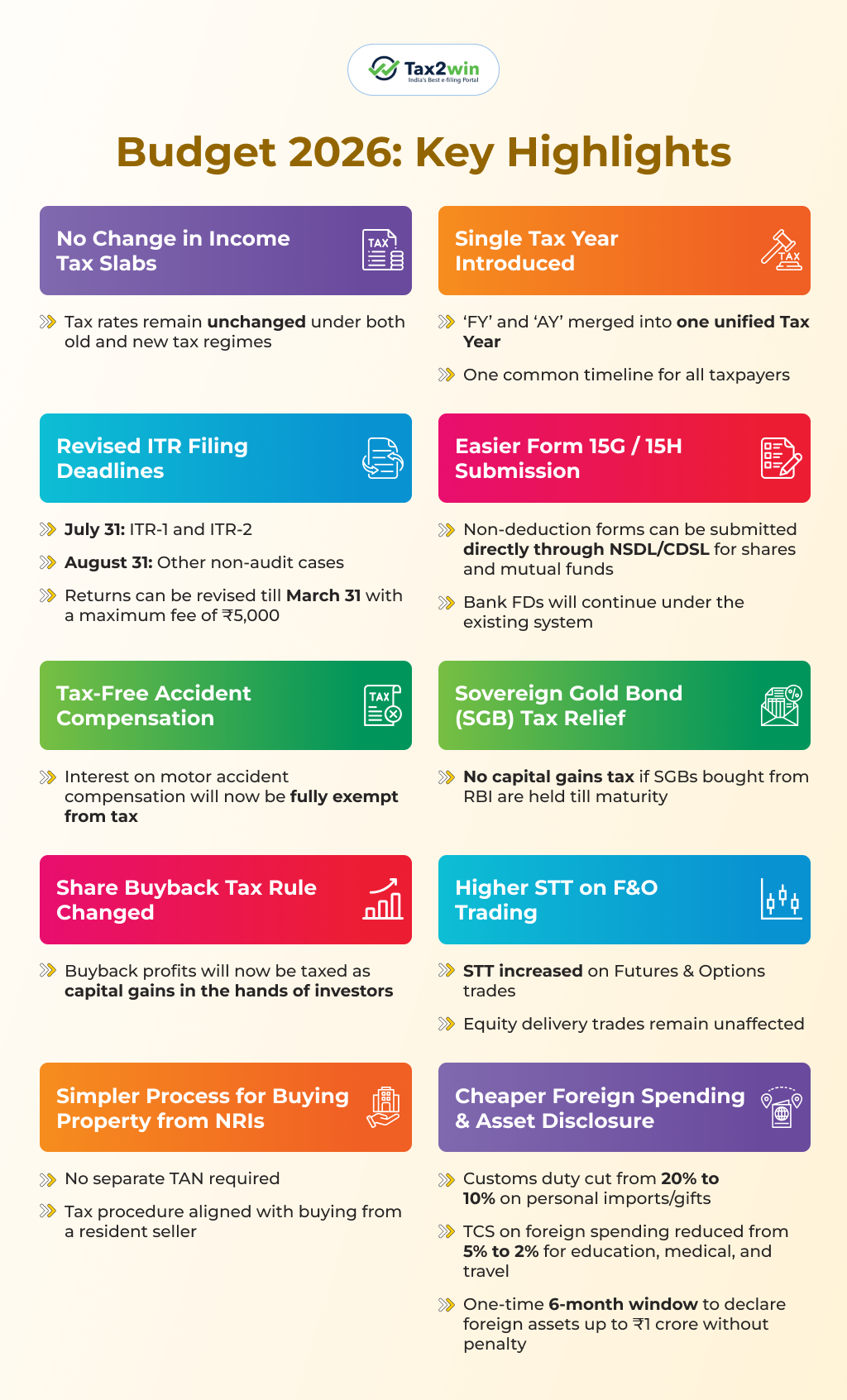
- No changes in income tax slabs or tax rates under both old and new regimes.
- The government has provided stability, allowing individuals and businesses to plan taxes better.
-
A new simplified Income Tax Act will come into force from 1 April 2026, with:
- Clearer language
- Fewer explanations and provisos
- Reduced scope for disputes
Relief for Individual Taxpayers
- Interest received from Motor Accident Claim Tribunal (MACT) has been made fully tax-free.
- Any TDS deducted on such interest has been removed, improving cash flow for victims and families.
- Depositories can now accept Form 15G / Form 15H, even if investments are held across multiple companies.
- Small taxpayers can now obtain lower or nil TDS certificates through a fully automated, rule-based process, reducing dependency on manual approvals.
ITR Filing & Return Revision
- Time limit to revise Income Tax Returns extended till 31st March (earlier 31st December).
- A nominal fee will apply for revisions after the original deadline.
-
ITR filing due dates clarified:
- ITR-1 and ITR-2 → 31st July
- Non-audit business cases and trusts → 31st August
- Taxpayers are now allowed to update their returns even after reassessment proceedings have started, by paying an additional 10% tax.
- This change encourages voluntary compliance and faster dispute resolution.
TDS & TCS Changes
- TCS on overseas tour packages reduced to 2%, easing cash flow for travellers.
- TCS on education and medical expenses under LRS reduced to 2%.
- TDS on manpower supply services standardised at 1% or 2%, reducing confusion.
- For NRIs selling property in India, TDS will now be deposited using the buyer’s PAN instead of TAN, simplifying compliance.
Foreign Assets & NRI Tax Relief
- Introduction of a one-time 6-month foreign asset disclosure scheme for small taxpayers with low-value foreign assets.
- Immunity from prosecution (retrospective from 1 October 2024) for non-disclosure of non-immovable foreign assets with total value below ₹20 lakh, subject to conditions.
- Global income of notified non-resident experts exempt from tax for up to 5 years, to attract global talent.
- MAT exemption extended to non-residents paying tax under presumptive schemes.
Decriminalisation & Dispute Resolution
- Non-production of books of accounts decriminalised, reducing fear of prosecution.
- Delay in TDS payment decriminalised, shifting focus from punishment to compliance.
- Honest taxpayers willing to settle disputes can now close cases by paying an additional amount instead of facing penalties.
- Immunity from penalty and prosecution extended even to certain cases of misreporting, under prescribed conditions.
MAT & Share Buyback Taxation
- Minimum Alternate Tax (MAT) proposed to be treated as final tax, reducing future litigation.
- MAT credit set-off allowed up to 25% of tax liability under the new regime.
- Share buybacks to be taxed as capital gains for all shareholders.
- Promoters to pay additional buyback tax, ensuring equitable taxation.
Economy & Fiscal Discipline
- Fiscal deficit for FY 2026–27 targeted at 4.3% of GDP.
- Government aims to reduce debt-to-GDP ratio to around 50% by 2030.
- Public capital expenditure increased to ₹12.2 lakh crore, continuing strong infrastructure push.
- Inflation expected to remain moderate, supporting consumption and investment.
Manufacturing & ‘Make in India’ Push
- Launch of India Semiconductor Mission 2.0 to strengthen chip manufacturing ecosystem.
-
New schemes announced for:
- Electronics components
- Textiles and apparel
- Chemicals and petrochemicals
- Container manufacturing
- Construction and infrastructure equipment
- 200 legacy industrial clusters to be revived to generate employment.
-
Customs duty exemptions provided for:
- Aircraft and defence manufacturing
- Footwear and textile exports
- Seafood exports
- Faster customs clearance for trusted importers.
MSME Growth & Support
- ₹10,000 crore SME Growth Fund to support expansion and job creation.
- Mandatory use of TReDS platform by CPSEs for MSME payments.
- GeM linked with TReDS to ensure faster payments and cheaper financing.
- Credit guarantee support for MSME invoice discounting.
- Corporate Mitras to help MSMEs with compliance, especially in Tier-II and Tier-III cities.
Infrastructure & Connectivity
- 7 high-speed rail corridors connecting major cities.
- New Dedicated Freight Corridor (East–West) to reduce logistics costs.
- 20 new National Waterways to promote eco-friendly transport.
- ₹2 lakh crore support to states under SASCI scheme.
- Focus on Tier-II, Tier-III cities and temple towns as growth centres.
Energy Security & Green Growth
- ₹20,000 crore CCUS (Carbon Capture) scheme.
-
Customs duty exemptions for:
- Lithium-ion battery manufacturing
- Solar glass
- Nuclear power projects (extended till 2035)
- Critical mineral processing
- Entire value of biogas excluded from excise duty.
Agriculture & Rural Economy
- Launch of Bharat-VISTAAR, an AI-based platform integrating AgriStack and ICAR.
- Focus on fisheries, horticulture, animal husbandry, and high-value crops.
- Development of 500 reservoirs and Amrit Sarovars.
- Support for women-led and rural agri-entrepreneurship.
Education, Healthcare & Social Welfare
- 5 university townships near industrial corridors.
- Girls’ hostels in STEM institutions in every district.
- Training of 1.5 lakh caregivers under the care economy.
- Expansion of medical tourism and AYUSH institutions.
- Strengthening mental health infrastructure and trauma care.
- Dedicated schemes for Divyangjan including skill training and assistive devices.
Conclusion: What Budget 2026–27 Means for Taxpayers & Businesses
The Union Budget 2026–27 is a reform-driven and stability-focused budget that prioritises long-term economic health over short-term tax giveaways. While there are no headline tax rate cuts, the Budget delivers meaningful relief by simplifying direct tax laws, reducing compliance requirements, and lowering the risk of litigation through decriminalisation.
The emphasis on trust-based governance, automated processes, and clearer rules makes tax compliance easier and less stressful for individuals and businesses alike. At the same time, strong government spending on infrastructure, MSMEs, and domestic manufacturing is expected to support job creation and sustainable growth. Overall, Budget 2026–27 strikes a careful balance between fiscal discipline and growth, making it a steady and forward-looking budget for both taxpayers and businesses.